

Key Takeaways
How to Look Younger and Thinner — Without Changing a Thing
- Wearing your skin tone colors can make you look up to 10 years younger — and wearing the wrong ones can age you just as fast in the opposite direction.
- Strategic contrast and the diagonal line are two of the most underused styling tools for a radiant, elongated appearance.
- Looking younger isn’t about what you add — it’s about alignment between your natural coloring and what you wear.
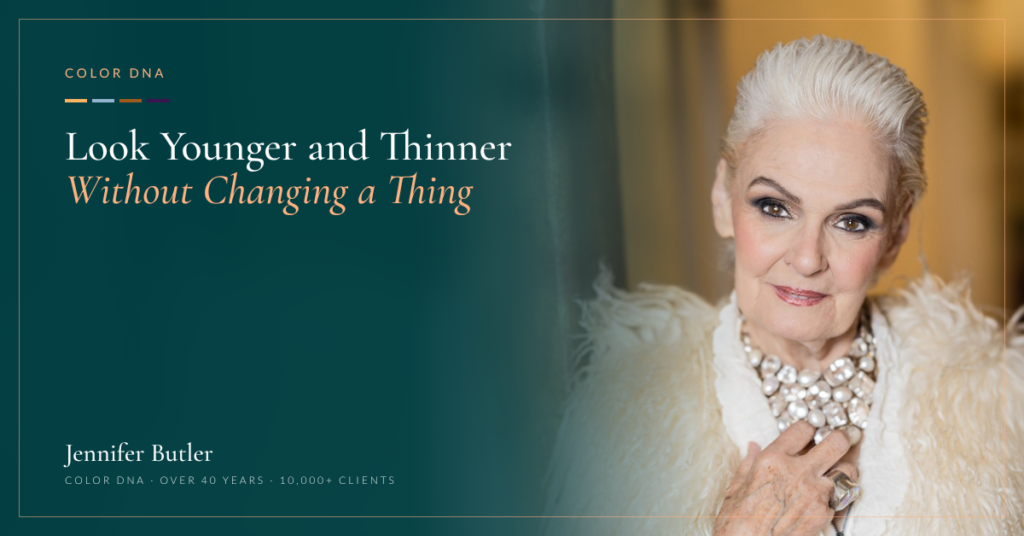
- At 78, Jennifer Butler credits essence-based dressing — not anti-aging products — for her vitality and radiance.
Two of the most common things I hear from women are: “I want to look younger” and “I want to look thinner.”
And I understand. We live in a world that sells solutions to both — serums, shapewear, filters, formulas. Most of them work temporarily. None of them work the way understanding your own coloring and design does.
Because here’s what I’ve discovered in over 40 years of color and design work, including a decade in the New York fashion industry: looking younger and looking thinner aren’t primarily about products or even about clothing. They’re about alignment. When what you wear works with your natural coloring and geometry instead of against it, the effect is immediate, effortless, and lasting.
I’m 78. I dress as a celebration of myself every single day. And I’m about to show you exactly how.
The Single Fastest Way to Look 10 Years Younger
Wear your skin tone.
I know that sounds almost too simple. But watch what happens when I demonstrate it — when I hold a color close to my face that echoes the tones already in my skin — and then replace it with something that doesn’t. The difference isn’t subtle. It’s immediate. The right color illuminates. The wrong one dulls.
Here’s the principle behind it: when the colors you wear echo the undertones already present in your skin, eyes, and hair, your natural coloring gets amplified. Your skin looks more alive. Even your eyes look brighter. Your face looks more awake — not because anything changed, but because nothing is competing with you anymore.
The wrong color does the opposite. It creates a visual argument between your face and your clothing — and your face loses. Shadows deepen. Fine lines become more visible. You look, as I often say, about 10 years older than you actually are.
I’ll give you a personal example. If I were to wear a dusty pink — a color that might look beautiful on its own — it would immediately age me. Not because dusty pink is a bad color. Because it isn’t my color. It doesn’t echo my undertone. It competes with it. And that competition is what the camera — and every person you meet — picks up instantly.
Finding your skin tone colors isn’t about picking what you like. It’s about identifying the colors that already exist in your pigment and building outward from there. When you get this right, the anti-aging effect is real, measurable, and requires no product whatsoever.
Why Contrast Is the Radiance Multiplier Nobody Talks About
Skin tone is the foundation. Contrast is what makes it sing.
Here’s what I mean. Even when you’re wearing your right colors, covering up your natural contrast — the interplay between your face, your neckline, your coloring — dims your radiance. The moment you obscure that visual interest, something goes flat. You can feel it even in photographs. Something that was alive becomes ordinary.
Your natural contrast — however high or low it is — is part of your design. It’s the dynamic energy in your appearance, the thing that makes your face readable and your presence felt. When you work with it instead of against it, you don’t just look better. You look lit from within.
For higher-contrast colorings, this often means not covering the neckline — letting the interplay between face, neck, and clothing create visual energy. For lower-contrast colorings, it means keeping that same soft, harmonious flow rather than introducing jarring breaks. Either way, the principle is the same: honor what’s already there. Don’t cover it up.
This is why the “just throw on a scarf” or “cover it with a cardigan” advice so often backfires. Coverage isn’t always concealment. Sometimes it’s erasure — and what gets erased is your radiance.
The Diagonal Line — Nature’s Most Slimming Tool
This third principle is one I come back to constantly because it works on almost every body and almost every face shape: the diagonal.
The diagonal mirrors the jawline. And when clothing and jewelry echo that diagonal angle — rather than creating harsh horizontal or vertical lines — the effect is both slimming and softening. It draws the eye along a natural, flowing path rather than cutting the body into sections or emphasizing width.
You can see this in action with something as simple as a draped vest, an asymmetrical neckline, or jewelry worn at an angle. These aren’t arbitrary style choices. They’re geometric decisions — ones that work because they’re in conversation with the natural lines of your face and body rather than imposing a foreign geometry onto them.
This is what I mean when I talk about sacred geometry in dressing. Your body already has a geometry. Your face already has angles and planes. The clothing that makes you look most elegant, most elongated, and most radiant is the clothing that understands and honors those existing lines — not the clothing that tries to override them with trends or formulas.
The diagonal is one of the simplest applications of this principle. And once you start seeing it, you can’t unsee it — in every outfit that works effortlessly and in every one that somehow falls short despite being technically correct.
Putting It All Together: Your Three-Step Radiance Checklist
Before you get dressed tomorrow morning, run through these:
- Skin tone first. Does this color echo the undertones in your skin, or does it compete with them? If it competes — if it makes your skin look flat, shadowed, or dull — it doesn’t belong near your face, regardless of how much you love it on the hanger.
- Check your contrast. Are you working with your natural contrast or covering it up? If the neckline or silhouette is obscuring the visual energy of your coloring, consider what opens up instead.
- Find the diagonal. Does your outfit include at least one diagonal line — in the cut, the drape, the layering, or the jewelry? If everything is strictly horizontal or vertical, look for a simple way to introduce angle.
- Ask the real question. Does this feel like a celebration of who I am today, or does it feel like a costume? Dressing as a daily act of self-celebration isn’t vanity — it’s the practice that keeps you connected to your own vitality.
- Take the Seasonal Essence Quiz. If you’re not certain which colors belong to your skin tone, this is the place to start. Your Color DNA is the foundation everything else builds from.
Why Alignment Matters More Than Any Product
These three principles — skin tone, contrast, diagonal — aren’t style tricks. They’re design principles drawn from nature and from decades of watching what actually works on real women in real life.
Looking younger, looking more radiant, feeling more like yourself — none of it requires a new product, a new diet, or a dramatic transformation.
It requires alignment. Between your coloring and your clothing. Between your natural geometry and the lines you choose to wear. And, above all, between who you are on the inside and what the world sees on the outside.
I’m 78 and I’m genuinely getting better. Not despite my age — because of the work of connecting more deeply with my own essence every year. That connection is available to you too. It starts with your colors.
Your skin-tone colors are part of your personal palette. Learn how to find your color palette at home, or read my complete guide to personal color analysis. Then learn how to dress in your colors with my guide to color analysis for clothes.
Frequently Asked Questions
What colors make you look younger?
The colors that make you look youngest are the ones that echo your own skin undertones — what color analysts call your “skin tone colors.” These amplify your natural radiance rather than competing with it. Wearing colors that clash with your undertone creates visual dissonance that deepens shadows and emphasizes lines, adding years to your appearance. The right colors, by contrast, can take up to 10 years off your visible age — with no products required.
How does contrast affect how young or radiant you look?
Your natural contrast — the interplay between your skin, hair, and eyes — is a key part of your visual energy. When you honor that contrast rather than covering it up, your face looks more alive and radiant. Obscuring your natural contrast with heavy layering or coverage at the neckline can flatten your appearance and dull the natural vitality of your coloring.
What is the diagonal line in fashion and why does it matter?
The diagonal in clothing refers to angled lines in cuts, drapes, layering, or jewelry that mirror the natural angle of the jawline. Because diagonal lines follow the body’s natural geometry rather than imposing horizontal or vertical breaks, they create a slimming, elongating effect and draw the eye along a more flattering path. Even a simple piece of jewelry worn at an angle can introduce this effect immediately.
Can the way I dress really make me look 10 years younger?
Yes — and the mechanism is simpler than most people expect. When your clothing colors harmonize with your skin undertones, your natural coloring is amplified rather than dulled. The result is a more radiant, awake, and youthful appearance that no filter can replicate because it’s coming from actual alignment between your exterior and your natural design. The reverse is equally true: the wrong colors can add years just as quickly.
What is sacred geometry in dressing?
Sacred geometry in dressing refers to the natural proportions, angles, and forms already present in your body and face — and the practice of choosing clothing that works in harmony with those existing lines rather than overriding them with arbitrary style rules. When your silhouettes, cuts, and accessories echo your natural geometry, your appearance feels effortless and coherent in a way that trend-based dressing rarely achieves.
Discover the Colors That Make You Radiant — Free
Take Jennifer’s free Seasonal Essence Quiz to identify your Color DNA — the specific palette that amplifies your natural coloring, supports your radiance, and helps you look and feel your most vital self. Over 7,000 women have started here.